
Intelligence Applied
WorkPath
A personal AI readiness profile.
Built for each job.
Fluency and judgment, demonstrated.
15
Scenarios
3
Dimensions
≈30
Minutes
Intelligence Applied
A personal AI readiness profile.
Built for each job.
Fluency and judgment, demonstrated.
The Opportunity
But that has proved elusive. AI advantage isn't something you install. It takes fluency and judgment. And those vary from one individual, one organization, to the next.
One person has built real AI skill and has no way to show it. One organization has emerging AI capability and has no way to see it as a whole.
WorkPath makes AI fluency and judgment visible. It reads how people respond to scenarios drawn from their own work. It turns that into a personal profile, portable and credible. Across a group, those profiles let an organization see its capability as a whole. They become a shared basis for discussion, development, and action.
"We're not testing what you know about AI. We're reading how you navigate when AI is part of the work."
What It Is
The WorkPath Profile places you inside realistic workplace situations and reveals how you think. It isn't pass/fail, and there are no trick questions. The result is a personalized written profile: a clear picture of your AI fluency and judgment today, and what your next growth could look like.
Who It's For
You made the AI investment. Tools are deployed, budget is committed, a policy may already be written. What you don't have is a read on how well your people are using any of it.
Run WorkPath across a team and the pattern surfaces. Set aside an hour and look at it together.
Use this profile to decide about tools, training, and policy from evidence rather than anecdote.
Your work is building AI readiness in the people you serve. The hard part is showing what the program produced. WorkPath runs the same read across every learner, every cohort, every role, so growth is measured the same way wherever you point it.
Learners leave with direction on every scenario, drawn from that same standard, not generic AI tips, so the profile is a learning resource in itself.
Use this profile to show what your program builds.
You built your own way of working with AI. Most of it you learned by doing the work, and nothing on paper shows it.
WorkPath puts it in writing: where you're strong, where you're still forming, and the one move that would put you ahead.
Use this profile to direct your own development and to demonstrate what you can do.
How It Works
Tier 1
Five scenarios, each a moment when AI is part of the job. You say what you would do and why, in a few sentences. There is nothing to pick from a list and nothing to memorize.
Tier 2
The same kind of scenario, with a short break first so the thinking stays fresh. Most people finish all fifteen in about half an hour.
Tier 3
The last five, focused on what your first ten didn't show. No two people get the same set.
What We Measure
A working model of what generative AI actually is: a tool that produces plausible output from statistical estimation, not settled fact looked up on command. Strong orientation holds up on unfamiliar ground.
What you have AI do and how you set it up: helping you think through your work, completing whole tasks, or setting up work to run automatically. Strong integration fits AI to the task at hand.
Deciding whether to use AI, what role it should have, and what to do or decide yourself; judging its work for accuracy and fit with the situation; and taking responsibility for the result, however much AI did. The greater the possible consequences, the closer the review.
Each dimension is placed on one of three bands.
What You See
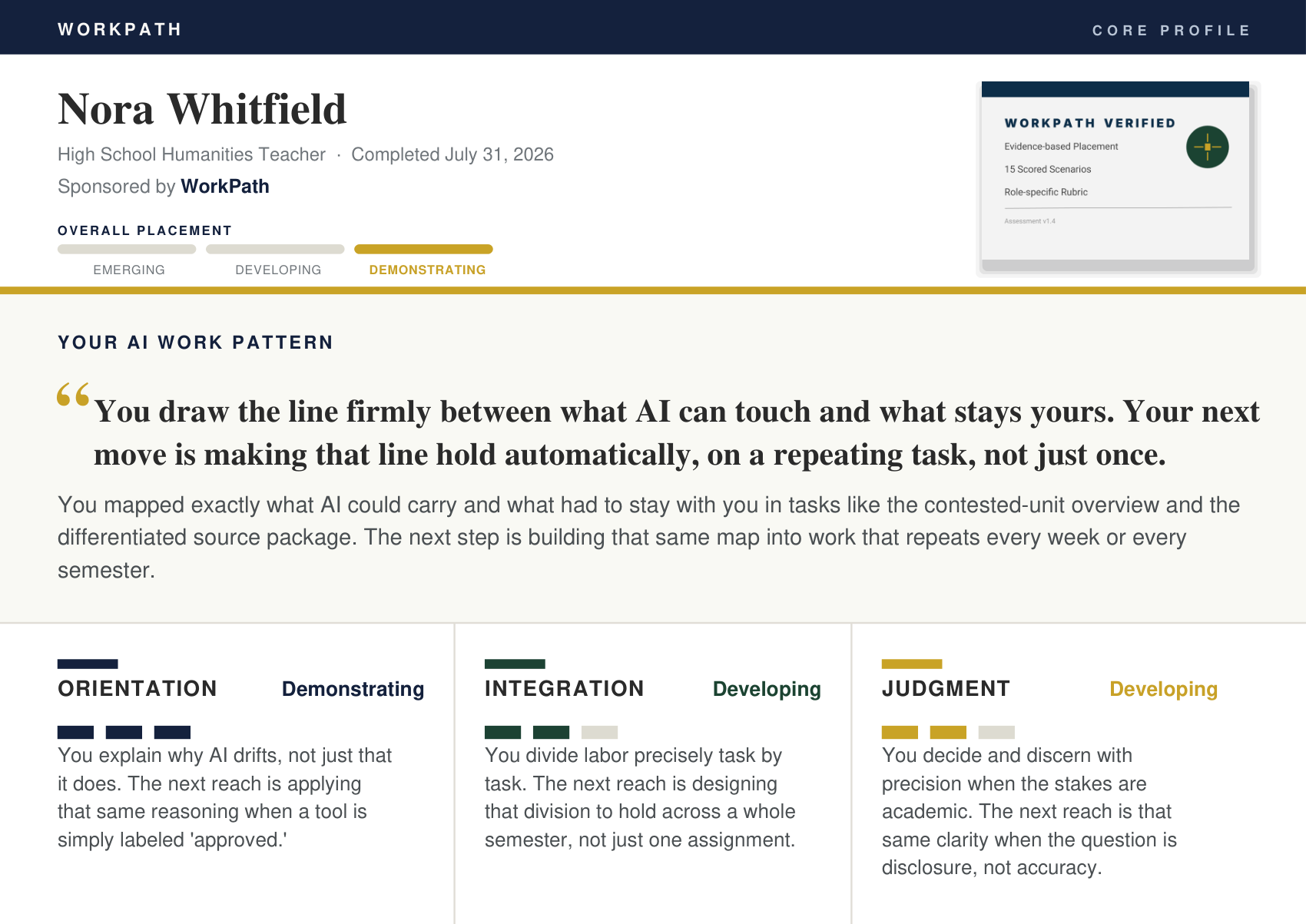
Every profile is written for one person: grounded in their own words, scored against rubrics built for their role, and drafted with AI.
A Note
I built WorkPath because I see people mystified by AI. There's all the hype. There's the real capability people experience firsthand. But its impact at work remains slow and uneven.
There's also a group of people who are doing amazing things with it. They need a way to demonstrate that to employers, customers, and themselves.
Under all of it is a question I keep coming back to. As AI becomes more powerful, what is our role at work? What is ours to do?
My answer so far has four parts. Someone has to comprehend the work, judge it, stand behind it, and authorize what happens next. Whatever we assign AI to do, those stay ours.
A WorkPath scenario brings that question into view. It puts a person in a moment from their own job, with AI in reach, and asks what they would do. The profile shows how they answered, in their own words, and what to build next.
And when you write to us, I'm the one who answers.
Randy Sparkman
WorkPath Developer

Get Started
A complete profile from a real assessment, with the name removed. The same document your people would receive.
A person reads every request, so it won’t be instant.
Would you rather take the assessment yourself? Say so in your message and we’ll send you an access code.
Request received
We’ll send a sample profile to . A person reads every request, so it won’t be instant.
Not sure yet? Watch the 3-minute overview
Thinking about a pilot for your organization? Write to us directly.